Choosing a video format functions as an operational decision. Short versions tend to stumble when they postpone the payoff, and long versions tend to drop viewers before the core argument finishes. A defensible comparison for 2026 isolates commercial return, audience completion, and editorial cost as distinct variables.
What are the verified benchmarks for short form vs long form video ROI and completion rate benchmarks 2026?
The engagement benchmark dates to 2025 Wistia Video Engagement Benchmark, 2025. For 2026 planning it offers a baseline, rather than a forecast tied to a specific channel.
| Decision measure | Verified benchmark | Operating use |
|---|---|---|
| Positive video ROI | 93% of marketing teams investing in video report positive ROI Wyzowl Video Marketing Report, 2026 | Pair platform reach with qualified revenue or pipeline contribution |
| Prior-cycle positive ROI | 87% reported positive ROI Wyzowl Video Marketing Report, 2026 | Separate broad adoption from format-level performance |
| Long-form completion | Videos over 30 minutes average near 26% completion Wistia Video Engagement Benchmark, 2025 | Set long-form retention expectations before scripting |
| Focused mid-form retention | 5-to-10-minute edits retain 46% to 52% of viewers Wistia Video Engagement Benchmark, 2025 | Use as a tighter-duration reference, not a universal short-form score |
| Freelance editing rate | $55 to $120 per hour in North America and Western Europe ProductionHUB & Editorial Rate Survey, 2025 | Price revisions into the campaign cost model |
| Post-production load | Polished YouTube video takes 30 to 60 minutes of post-production per finished minute ProductionHUB & Editorial Rate Survey, 2025 | Translate master length into an editor-hour estimate |
Completion figures in the table reflect benchmarks organized by duration. Because a 60-second vertical cut and a 5-to-10-minute mid-form edit serve separate audience slots, cohort data native to each platform should provide the final judgment. For ROI, combine qualified revenue or pipeline contribution with labor, review, and tooling costs. Raw view counts indicate reach without confirming return.
In surveys fielded across 2025–2026, more than 75% of professional video editors reported using at least one AI-powered tool for transcription, silence removal, audio cleanup, or generative extension in their weekly work Adobe Future of Creativity & Post-Production Survey, 2025. Routine passes move faster with AI, yet human QC remains required to catch transcript errors, speaker mix-ups, pacing gaps, and visual discontinuities.
Step-by-step Premiere Pro and DaVinci Resolve setup for short form vs long form video ROI and completion rate benchmarks 2026
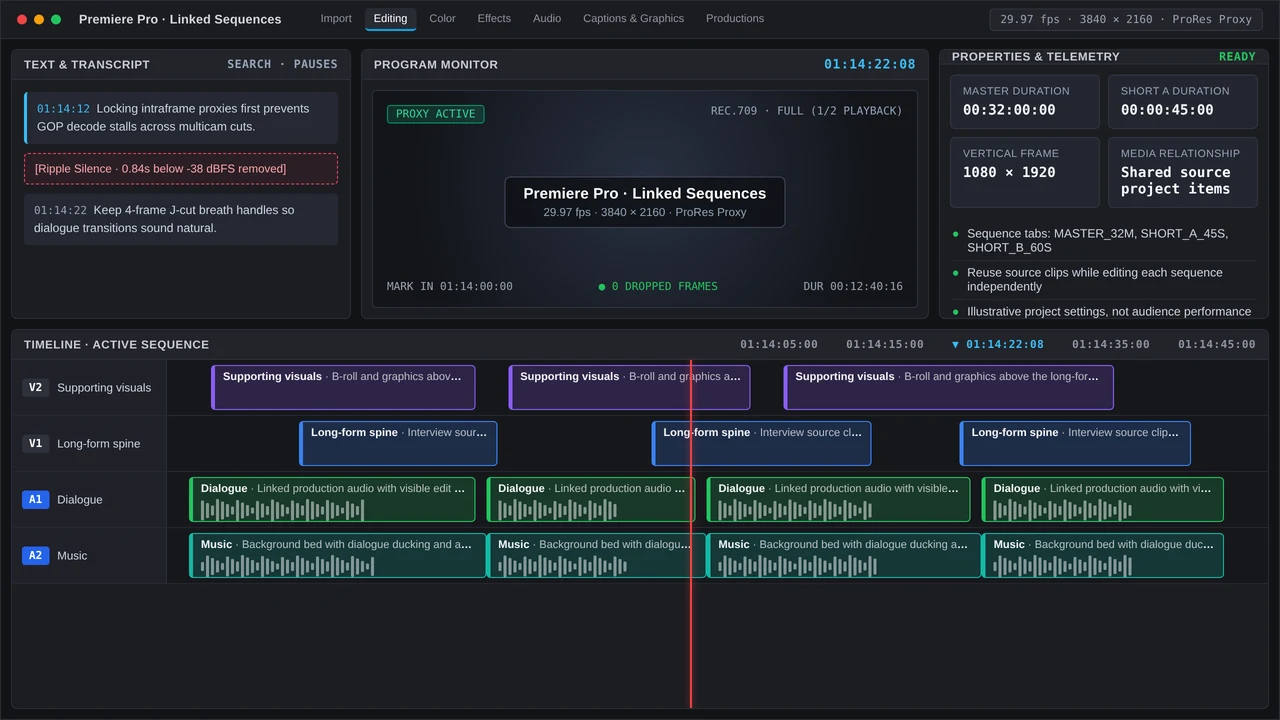
Maintain a single source library, one master for long-form, and distinct sequences for derivatives. Rather than collapsing a dense master timeline, assemble short-form cuts from linked source clips. Align each program sequence to the camera frame rate prior to the initial edit pass.
Step-by-step Premiere Pro setup for short form vs long form video ROI and completion rate benchmarks 2026
- Ingest originals into labeled bins for selects, pickups, graphics, music, and deliverables.
- Create one long-form sequence and separate short-form sequences per platform and concept.
- Match sequence frame rate to the camera originals and verify linked audio before editing.
- Open the Text panel to scan transcripts and bulk-detect pauses or filler; use the contextual Properties panel for transforms and the Graphics Templates panel for branded motion assets.
- Route versions to Frame.io, resolve marker-based comments, and lock approved cuts.
The native Text workflow in Premiere Pro enables bulk detection of pauses and filler, while zoom pacing, B-roll matching, or animated word-by-word presets still require extra assets for automation Adobe Premiere Pro, 2026.
Step-by-step DaVinci Resolve setup for short form vs long form video ROI and completion rate benchmarks 2026
- Ingest originals into Media bins with separate camera audio, music, graphics, and delivery files.
- Create long-form and derivative timelines, matching the camera frame rate before assembly.
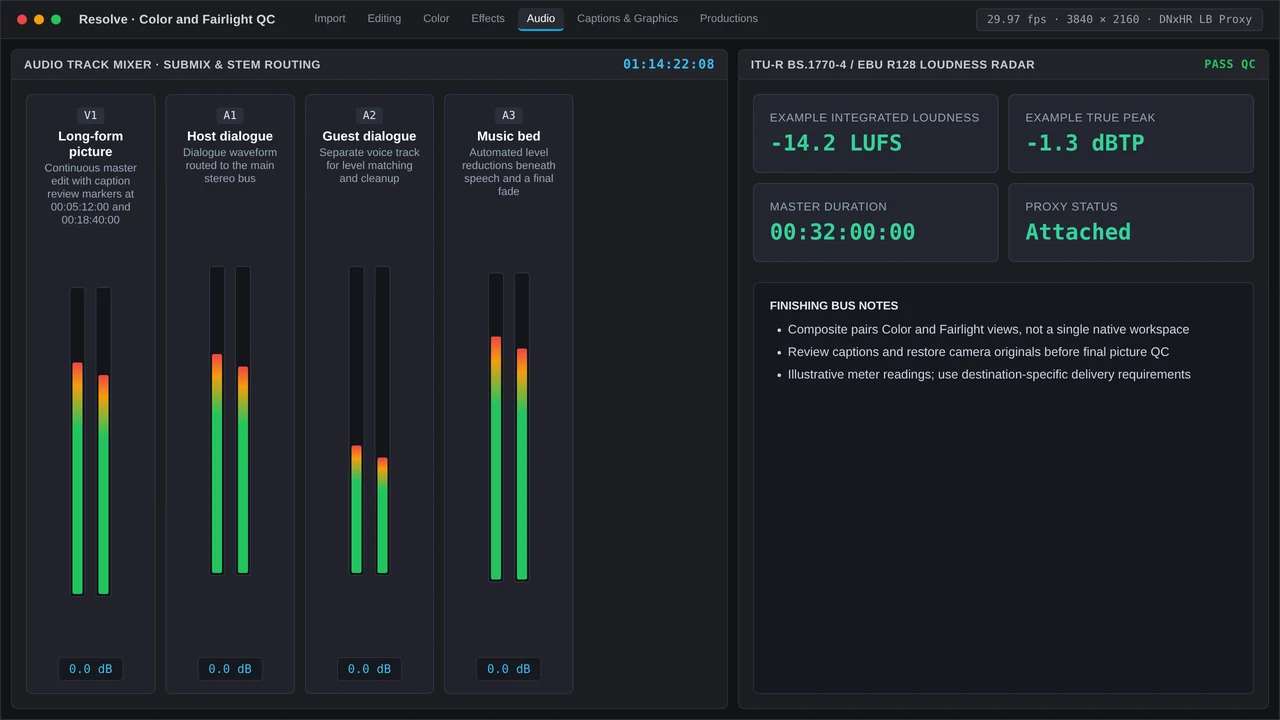
- Use the Edit page for structure, the Color page for shot matching, and Fairlight for dialogue and music.
- Run Neural Engine transcription for caption and filler-removal passes; use IntelliTrack where tracking supports the concept.
- Build short-form timelines from source clips, then send versions to Frame.io for timecoded approval.
Inside a single application, Resolve Studio unifies Color, Fairlight, transcription, and tracking, although a smaller ecosystem for template extensions can delay handoffs built around templates Blackmagic Design, 2026.
| Tool | Published access price | Primary setup use |
|---|---|---|
| Premiere Pro | $23 per month for the single-app annual plan Adobe Premiere Pro, 2026 | Transcript-led assembly and template finishing |
| DaVinci Resolve Studio | $295 perpetual license Blackmagic Design, 2026 | Integrated edit, color, audio, and tracking |
| Frame.io Pro | $15 per user per month Frame.io, 2026 | Timecoded review and version control |
| Excalibur | $100 one-time license Knights of the Editing Table, 2026 | Deterministic Premiere Pro effects and timeline macros |
Verify current regional terms before purchasing, because labor and revision time drive the larger ROI variables.
Client review links structured around pinned timecode bring stakeholder revision loops down to a median of 2.4 rounds Frame.io Workflow Study, 2025. Through unthreaded email feedback, the comparison baseline rises to 4 or more rounds Frame.io Workflow Study, 2025. Mandate a single consolidated review pass and lock approved versions before derivative work starts.
Common timeline bottlenecks and QC checks when handling short form vs long form video ROI and completion rate benchmarks 2026
Common timeline bottlenecks for short form vs long form video ROI and completion rate benchmarks 2026
- Frame-rate drift: Cameras with mismatched sources create unwanted cadence shifts on an incorrect sequence setting.
- Offline media: Proxies that are missing or mismatched interrupt playback and weaken conform decisions.
- Derivative tangles: Nested sequences obscure the source cut behind a short-form shot and make revisions harder.
- Template and render pressure: Absent fonts, LUTs, motion templates, or plugin versions prevent final renders from completing.
Healthy boutique editing agencies aim for 65% to 75% billable utilization for editors Promethean Agency Operations Benchmark, 2025. The balance of 25% to 35% remains reserved for ingest, render queues, QC, and template upkeep Promethean Agency Operations Benchmark, 2025. Measure actual utilization before committing to high long-form volume alongside a large number of derivatives.
QC checks for short form vs long form video ROI and completion rate benchmarks 2026
| QC pass | Short-form delivery | Long-form delivery |
|---|---|---|
| Opening | Promise and payoff land without setup delay | Thesis and context are established before chapters advance |
| Text | Text panel timing, spelling, and safe areas are checked | Full transcript, speaker labels, and chapter terms are checked |
| Graphics | Graphics Templates fit the delivery frame and do not cover captions | Lower thirds, credits, and recurring graphics stay consistent |
| Audio | The final word resolves cleanly and music does not mask dialogue | Room tone, music transitions, and dialogue balance remain continuous |
| Delivery | Frame rate, final frame, file name, and destination format are verified | Master, captions, thumbnail frame, and upload package are verified |
Opt for short form when the proof concentrates into a single tight sequence and the objective calls for immediate response. Opt for long form when the audience requires demonstration, context, or durable trust. Before a final commitment, weigh platform cohort completion against qualified revenue, editing time, revision rounds, and tool cost. Log edit hours and revision rounds separately for the master and for each derivative sequence.